INTRODUCTION
This is the largest part of the brain situated in the anterior and middle cranial fossa.
It consists of two hemispheres. Both the cerebral hemispheres are separated by a deep vertical fissure into left and right cerebral hemisphere. The separation is incomplete, in middle portion; Corpus callosum is present which connects the two hemispheres. Surface of the cerebral cortex is characterized by complicated pattern of sulci and gyri. Sulcus is a slight depression or groove and gyrus is a raised ridge. This helps in increasing the surface area of brain.
Cerebral cortex consists of gray matter that surrounds the deeper white matter.
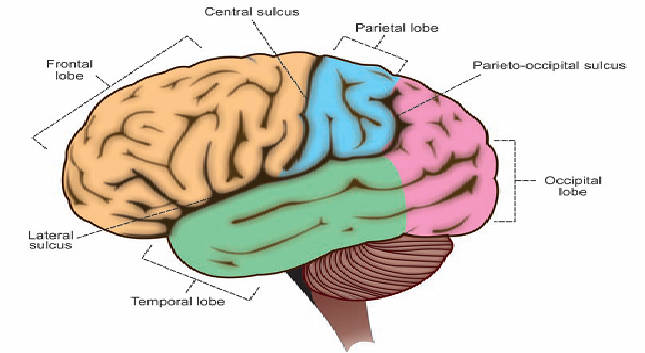
LOBES OF CEREBRAL CORTEX
In each hemisphere, there are three surfaces lateral, medial and inferior surfaces
1. Frontal lobe
2. Parietal lobe
3. Occipital lobe
4. Temporal lobe.
LOBES OF CEREBRAL CORTEX
Frontal Lobe of Cerebral Cortex
Functional areas
1. Primary motor area
2. Premotor area
Primary Motor Area- Areas 4 and 4S are present here.
Primary motor area is concerned with initiation of voluntary movements and speech.
Area 4S-It suppresses the extra impulses produced by area 4 and inhibits exaggeration of movements.
Premotor Area-Premotor area includes areas 6, 8, 44 and 45. The premotor area is anterior to primary motor area in the precentral cortex. The premotor area is concerned with control of postural movements.
Broca area-Broca area is the motor area for speech. It includes areas 44 and 45. Broca area is present in left hemisphere (dominant hemisphere) of right-handed persons and in the right hemisphere of left-handed persons
Function of Broca area-Broca area is responsible for movements of tongue, lips and larynx, which are involved in speech.
Parietal Lobe-It receives sensory impulses from cutaneous receptors (touch, pressure, pain, temperature) and proprioceptors.
Temporal Lobe
Functional areas
Wernicke area is responsible for the interpretation of auditory sensation. (Area 22)
Areas of Visual Cortex-
Occipital lobe consists of three functional areas:
1. Primary visual area (area 17) 2. Secondary visual area or (area18)
Functions of Occipital Lobe
2. Primary visual area (area 17) is concerned with perception of visual sensation
3. Secondary visual area (area 18) is concerned with interpretation of visual sensation and storage of memories of visual symbols
Author:PINKY CHOUDHARY