Two- Cavity Klystron
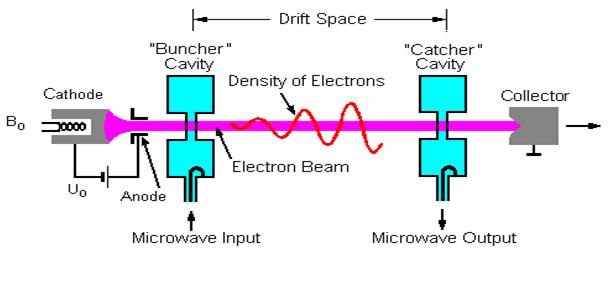
Klystron is the simplest vacuum tube that can be used for amplification or generation of microwave signal. The operation of klystron depends upon velocity modulation which leads to density modulation. Principle- …

Faculty: Law LLB III Year(V Sem.)Model Papers Sr. No. Paper Name Question Paper Link 1 Pleading, Drafting and Conveyance Click Here
Faculty: Law Post Graduate Diploma In Labour Law(PGDLL)Model Papers Sr. No. Paper Name Question Paper Link 1 Labour Jurisprudence and the International Labour Organization(I.L.O.) Click Here 2 Labour Law Labour Welfare, …
Faculty: Law LLB II Year(III Sem.)Model Papers Sr. No. Paper Name Question Paper Link 1 Bhartiya Nagrik Suraksha Sanhita Click Here
Klystron is the simplest vacuum tube that can be used for amplification or generation of microwave signal. The operation of klystron depends upon velocity modulation which leads to density modulation. Principle- …
Klystron is the simplest vacuum tube that can be used for amplification or generation of microwave signal. The operation of klystron depends upon velocity modulation which leads to density modulation.
Principle- high velocity electron beam is formed, focused and sent down along a glass tube to a collector electrode, which is at a high positive potential with respect to the cathode.
The input and output are taken from the tube via resonant cavity. The region between buncher cavity and catcher cavity is called drift space. The first electrode controls the number of electrons in the electron beam and focuses the beam. The velocity of the electrons in the beam is determined by the beam accelerating potential. When electrons travel through the drift space, they are subjected to RF potential at a frequency determinate by the cavity resonant frequency. The amplitude of this RF potential between the grids is determines by the amplitude of the input signal in case of an amplifier or by the amplitude of the feedback signal from the second cavity if used as an oscillator.
In velocity modulation, three cases are taken. Firstly, there is no applied voltage and as such electrons passing through the gap A are unaffected and will reach the collector with the …
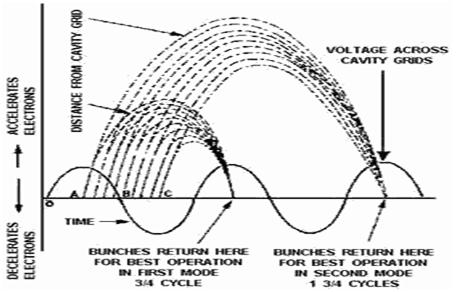
In velocity modulation, three cases are taken. Firstly, there is no applied voltage and as such electrons passing through the gap A are unaffected and will reach the collector with the same constant velocities.
At point B on the input RF cycle, the alternating voltage is zero and the electrons which passes through the gap A is unaffected by the RF signal (Reference electron, eR).
Secondly, consider C point passing the gap slightly later than the eR, this late electron, eL is subjected to positive RF voltage so that eL is accelerated and catches eR.
Thirdly, consider point A of RF cycle, an electron passing the gap slightly before the eR, called early electron ee and this early electron is subjected to negative RF voltage so ee is retarded and as such eR catches ee. When the electron passes the buncher gap their velocity will be changed according to the input RF signal. This process is known as velocity modulation. The electrons bunch together as they travel in the drift space. The pulsating stream of electrons passes through the gap and excites oscillations in the output cavity. The density of electrons passing the gap B varies cyclically with time. This means the electron beam contains an ac current and variation in current density enables the klystron to have a significant gain and hence drift space converts the velocity modulation into current modulation.
