
Positivity
10 ways to spread positivity -If you’re successful half the time, try doubling your efforts. -We learn wisdom from failure much more than from success. -We often discover what will do, …

Faculty: Law LLB III Year(V Sem.)Model Papers Sr. No. Paper Name Question Paper Link 1 Pleading, Drafting and Conveyance Click Here
Faculty: Law Post Graduate Diploma In Labour Law(PGDLL)Model Papers Sr. No. Paper Name Question Paper Link 1 Labour Jurisprudence and the International Labour Organization(I.L.O.) Click Here 2 Labour Law Labour Welfare, …
Faculty: Law LLB II Year(III Sem.)Model Papers Sr. No. Paper Name Question Paper Link 1 Bhartiya Nagrik Suraksha Sanhita Click Here
10 ways to spread positivity -If you’re successful half the time, try doubling your efforts. -We learn wisdom from failure much more than from success. -We often discover what will do, …
10 ways to spread positivity
-If you’re successful half the time, try doubling your efforts.
-We learn wisdom from failure much more than from success.
-We often discover what will do, by finding out what will not do; and
probably he who never made a mistake never made a discovery.
-When you do what you fear most, then you can do anything.
– Find a good story each day and share it with at least three people.
-Be happy SO that other people get happy just by looking at you.
-The world is thinking about making money and here I am thinking
about gaining wisdom! I can sometimes laugh at myself and my ways of
thinking, but the best part about my openness, aims and strives is that I
know they fulfill me, enrich me, satisfy me and most of all make me
happy.
-You can’t change others, but you can change your mind about how
much their words matter. Knowing how to build self-confidence is vital
to reducing stress and overwhelm. When you’re confident, you feel free
and look forward to your future.
-It’s important to choose friends wisely because your friends say a lot
about you as a person and some of them say a lot about you behind your
back.
-Understand that you don’t have to say, “Yes” to everything. Nervous
breakdowns are the body’s way of saying, “Enough!” and taking a
break to heal.
INTRODUCTION This is the largest part of the brain situated in the anterior and middle cranial fossa. It consists of two hemispheres. Both the cerebral hemispheres are separated by a deep …
INTRODUCTION
This is the largest part of the brain situated in the anterior and middle cranial fossa.
It consists of two hemispheres. Both the cerebral hemispheres are separated by a deep vertical fissure into left and right cerebral hemisphere. The separation is incomplete, in middle portion; Corpus callosum is present which connects the two hemispheres. Surface of the cerebral cortex is characterized by complicated pattern of sulci and gyri. Sulcus is a slight depression or groove and gyrus is a raised ridge. This helps in increasing the surface area of brain.
Cerebral cortex consists of gray matter that surrounds the deeper white matter.
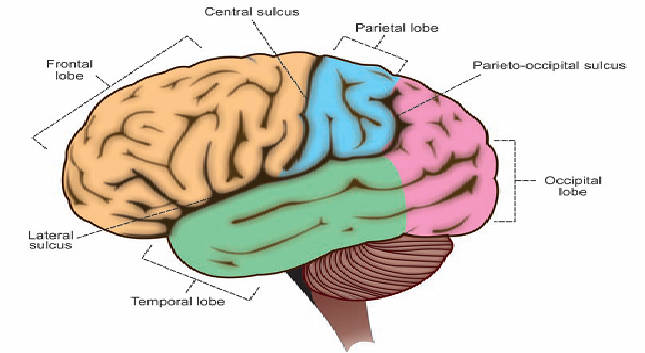
LOBES OF CEREBRAL CORTEX
In each hemisphere, there are three surfaces lateral, medial and inferior surfaces
1. Frontal lobe
2. Parietal lobe
3. Occipital lobe
4. Temporal lobe.
LOBES OF CEREBRAL CORTEX
Frontal Lobe of Cerebral Cortex
Functional areas
1. Primary motor area
2. Premotor area
Primary Motor Area- Areas 4 and 4S are present here.
Primary motor area is concerned with initiation of voluntary movements and speech.
Area 4S-It suppresses the extra impulses produced by area 4 and inhibits exaggeration of movements.
Premotor Area-Premotor area includes areas 6, 8, 44 and 45. The premotor area is anterior to primary motor area in the precentral cortex. The premotor area is concerned with control of postural movements.
Broca area-Broca area is the motor area for speech. It includes areas 44 and 45. Broca area is present in left hemisphere (dominant hemisphere) of right-handed persons and in the right hemisphere of left-handed persons
Function of Broca area-Broca area is responsible for movements of tongue, lips and larynx, which are involved in speech.
Parietal Lobe-It receives sensory impulses from cutaneous receptors (touch, pressure, pain, temperature) and proprioceptors.
Temporal Lobe
Functional areas
Wernicke area is responsible for the interpretation of auditory sensation. (Area 22)
Areas of Visual Cortex-
Occipital lobe consists of three functional areas:
1. Primary visual area (area 17) 2. Secondary visual area or (area18)
Functions of Occipital Lobe
2. Primary visual area (area 17) is concerned with perception of visual sensation
3. Secondary visual area (area 18) is concerned with interpretation of visual sensation and storage of memories of visual symbols
