
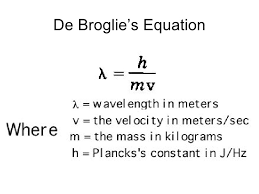
De-Broglie’s Equation (Quantization of angular momentum)-
Bohr could not give the reason of whole number of n in angular momentum mvr = nh/2π equation de- Broglie assumed that in the phenomenon of interference or diffraction the distance …
Faculty: Law Post Graduate Diploma In Labour Law(PGDLL)Model Papers Sr. No. Paper Name Question Paper Link 1 Labour Jurisprudence and the International Labour Organization(I.L.O.) Click Here 2 Labour Law Labour Welfare, …
Faculty: Law LLB II Year(III Sem.)Model Papers Sr. No. Paper Name Question Paper Link 1 Bhartiya Nagrik Suraksha Sanhita Click Here
Faculty: Law B.A. LL.B VII Semester Model Papers Sr. No. Paper Name Question Paper Link 1 Property Law Click Here
Bohr could not give the reason of whole number of n in angular momentum mvr = nh/2π equation de- Broglie assumed that in the phenomenon of interference or diffraction the distance …
Bohr could not give the reason of whole number of n in angular momentum
mvr = nh/2π equation
de- Broglie assumed that in the phenomenon of interference or diffraction the distance covered by electron should be integral multiple of wavelength (λ) . Since electron moves in circular path so it can move in only in those orbits whose circumference is some integral multiple of wavelength. Therefore,
2πr=nλ ……………….(a)
or 2πr =n.h/mv
or mvr = nh/2π …………………(b)
Above equation (b) is nothing but the Bohr’s hypothesis for circular motion of electron. Thus de-Broglie gave logical explanation of Bohr’s concept Fig. gives the Bohr’s and de-Broglie’s circular paths of electron. If nλ (5 λ) is a whole number, only then eaves will be in phase (fig. a), otherwise they will not be in phase (fig.b) in which n is not whole number. It means orbit (fig. b) is not allowed.

Conclusions from de-Broglie’s Equation : Following conclusions may be drawn from the de-Broglie’s equation .
de-Broglie’s wavelength λ is significant only for very minute particles like electron , photon etc. It is not significant for heavier particles for which mass (m) is very large so wavelength will be almost negligible (since λ = 1/m)
Wavelength is inversely proportional to the velocity of the particle Thus; wavelength for a stationary particle is indeterminate.
Wavelength does not depend upon the nature and charge of particle.
De-Broglie’s wave (matter waves) are entirely different from electromagnetic waves).
Einstein or photochemical equivalence law is applicable only to the primary photochemical process or in other words as a result of primary absorption of one quantum, only one molecule undergoes dissociation …
Einstein or photochemical equivalence law is applicable only to the primary photochemical process or in other words as a result of primary absorption of one quantum, only one molecule undergoes dissociation and the products enter no further reaction. It means the ratio of number of molecules excited and number of quanta absorbed is 1:1.
In actual practice in most of the cases an activated molecule initiates a series of thermal reactions called secondary reactions as in the cases of chain reactions like between H2 and Br2 and H2 and Cl2 etc. As a result in such reactions many reactant molecules may undergo chemical change by absorbing one quantum only and the ratio deviates from 1:1.
To describe the deviation from 1:1 the term quantum efficiency or quantum yield (ϕ) was introduced . This can be defined as follows:
“It is the number of molecules which undergo chemical change per quantum of absorbed energy” or in other words the ratio of the number of molecules reacting in a given time and the number of quanta absorbed in the same time is called quantum efficiency or quantum yield .
?= No. of molecules reacting in a given time
___________________________________________
No. of quanta or photons absorbed in the same time
or
?= No. of moles reacting in a given time
___________________________________
No. of einsteins absorbed in the same time
or
?= Rate of chemical reaction
_______________________
No. of einsteins absorbed
or =
Rate of chemical reaction
____________________
No. of einsteins of light
or
?= -d[A]/dt
_____________
Energy of absorbed light
The concept of quantum yield can be extended to any physical or chemical reaction following light absorption. The quantum yield is dependent on the light intensity. The value of quantum yield vary from very low of 0.04 to very high value of the order of 106.
Experimental Determination of Quantum Yield or Efficiency
We have seen in the last section that quantum yield or efficiency is defined as
?=Rate of chemical reaction
Energy of absorbed light
Thus , in order to determine the value of quantum yield of photochemical reaction it is essential to known (i) Number of moles reacting and (ii) number of Einstien absorbed . Number of molecules reacting in given time can be determined by the chemical kinetics , since it is nothing but is the rate of reaction.
