Velocity Modulation
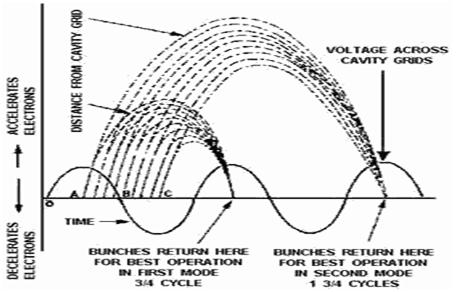
In velocity modulation, three cases are taken. Firstly, there is no applied voltage and as such electrons passing through the gap A are unaffected and will reach the collector with the …

Faculty: Law Post Graduate Diploma In Labour Law(PGDLL)Model Papers Sr. No. Paper Name Question Paper Link 1 Labour Jurisprudence and the International Labour Organization(I.L.O.) Click Here 2 Labour Law Labour Welfare, …
Faculty: Law LLB II Year(III Sem.)Model Papers Sr. No. Paper Name Question Paper Link 1 Bhartiya Nagrik Suraksha Sanhita Click Here
Faculty: Law B.A. LL.B VII Semester Model Papers Sr. No. Paper Name Question Paper Link 1 Property Law Click Here
In velocity modulation, three cases are taken. Firstly, there is no applied voltage and as such electrons passing through the gap A are unaffected and will reach the collector with the …
In velocity modulation, three cases are taken. Firstly, there is no applied voltage and as such electrons passing through the gap A are unaffected and will reach the collector with the same constant velocities.
At point B on the input RF cycle, the alternating voltage is zero and the electrons which passes through the gap A is unaffected by the RF signal (Reference electron, eR).
Secondly, consider C point passing the gap slightly later than the eR, this late electron, eL is subjected to positive RF voltage so that eL is accelerated and catches eR.
Thirdly, consider point A of RF cycle, an electron passing the gap slightly before the eR, called early electron ee and this early electron is subjected to negative RF voltage so ee is retarded and as such eR catches ee. When the electron passes the buncher gap their velocity will be changed according to the input RF signal. This process is known as velocity modulation. The electrons bunch together as they travel in the drift space. The pulsating stream of electrons passes through the gap and excites oscillations in the output cavity. The density of electrons passing the gap B varies cyclically with time. This means the electron beam contains an ac current and variation in current density enables the klystron to have a significant gain and hence drift space converts the velocity modulation into current modulation.
Immunology is the study of immune system and diseases related to immune system simply starting from allergy to very much complexed and dreadful diseases like AIDS, Hepatitis etc. There are various …
Immunology is the study of immune system and diseases related to immune system simply starting from allergy to very much complexed and dreadful diseases like AIDS, Hepatitis etc. There are various techniques to diagnose the diseases via identifying the presence of antibody or antigen in the serum of the patient. This forms the basis of the above said technique. Whole immune system is based on the interaction between antigen (foreign, non self material) and antibody (gamma globulins formed to combat Infection against that particular antigen). Interaction can be in form of agglutination (blood grouping) or precipitation. This interaction is liable for body’s defense against viral and bacterial infection. The antibody binds with more than one antigen depending upon its specificity or affinity for that antigen.
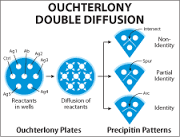
This technique is named after Orjan Ouchterloy, Swedish Physician in 1948. In this technique, both antigens and antibody are allowed to diffuse on the gel plate prepared by solidification of agarose gel on the plate and wells made onto this gel via gel puncture. Respective wells are filled with antigen and antibody by using micropipette and incubated in moist chamber for 24 hrs. a proper precipitation occurs when the amount of both antigens and antibody are at optimal concentration known as Equivalance point or Equilance zone. After 24 hrs, proper precipitin lines can be observed as a visual signature of antigen and antibody interaction. Three types of patterns are formed viz; pattern of full identity, pattern of partial identity and pattern of non identity. A full continuous line represents pattern of identity stating the immunologically similar nature of antibody for its respective antigen. Continuous line with formation of spur represents pattern of partial identity concluding antibody affinity for one particular antigen. Pattern of non identity is characterized by two crossing lines not meeting with each other concluding that antigens are immunologically not similar for their respective antigens.
Thus it can be concluded that by immunodiffusion assays immunological disesase (HIV, HEPATITIS) and presence of antigens and anibody in the serum.
