
What is GENE THERAPY
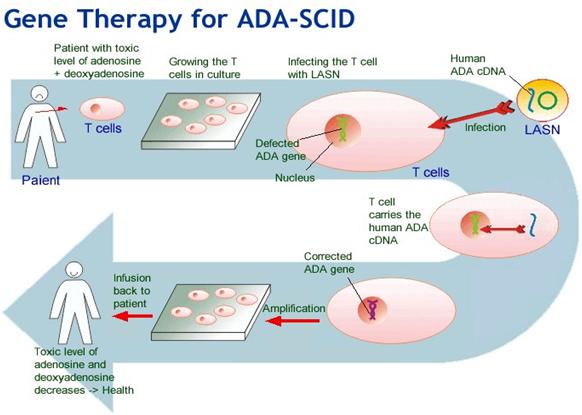
1. A new system of medicine gene therapy, may develop to treat some hereditary disease such as SCID, haemophilia etc. 2. It is the technique for curing genetic disease through replacing …

Faculty: Law Post Graduate Diploma In Labour Law(PGDLL)Model Papers Sr. No. Paper Name Question Paper Link 1 Labour Jurisprudence and the International Labour Organization(I.L.O.) Click Here 2 Labour Law Labour Welfare, …
Faculty: Law LLB II Year(III Sem.)Model Papers Sr. No. Paper Name Question Paper Link 1 Bhartiya Nagrik Suraksha Sanhita Click Here
Faculty: Law B.A. LL.B VII Semester Model Papers Sr. No. Paper Name Question Paper Link 1 Property Law Click Here
1. A new system of medicine gene therapy, may develop to treat some hereditary disease such as SCID, haemophilia etc. 2. It is the technique for curing genetic disease through replacing …
Transfer of desired genes from one organism into another is an important aspect of genetic engineering. Gene transfer is achieved by two kinds of transfer methods: (i) Indirect method …
Transfer of desired genes from one organism into another is an important aspect of genetic engineering.
Gene transfer is achieved by two kinds of transfer methods:
(i) Indirect method through vectors or carriers and
(ii) Direct or vector less transfer method
Vectorless Gene Transfer : Foreign genes can also be transferred directly by the following methods:
(a) Electroporation : It creates transients ( temporary pores) in the plasma membrane to facilitate entry of foreign DNA.
(b) Chemical mediated genetic transformation: It involves certain chemicals such as polyethylene glycol (PEG), that help in the uptake of foreign DNA into host cells.
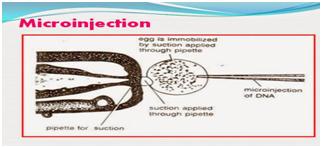
(c) Microinjection : It is the introduction of foreign genes into plant or animal cells using microinjection or glass needles.
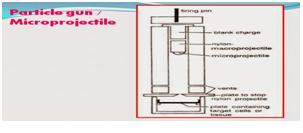
(d) Particle gun/ Biolistic method: It is a technique in which tungsten or gold particle coated with foreign DNA are bombarded into target cells to facilitate entry of the foreign genes.
(e) Liposome mediated gene transfer : In this method DNA encloses within lipid begs. These lipid begs fused with protoplast.