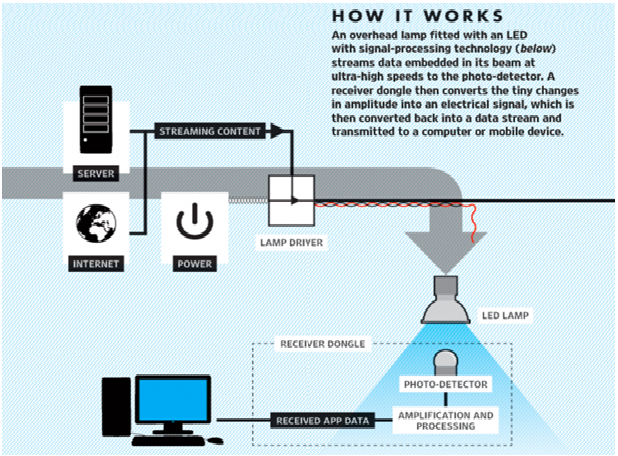
Li-Fi refers to visible light communications (VLC) technology, which delivers high-speed, bidirectional, networked mobile communications in a manner similar to Wi-Fi. It promises huge speed advantages, as well as more-secure communications and reduced device interference.
The term was coined by German physicist Harald Haas during a TED Talk when he outlined the idea of using lightbulbs as wireless routers. That address was delivered four years ago, and many people speculated that, like a lot of apparent revolutionary breakthroughs, Li-Fi would go the way of other “next big things” and not come to fruition. A year after his TED Talk, though, Haas, a professor of mobile communications at the University of Edinburgh, created pureLiFi with a group of people who had been researching the technology since 2008. The company has claimed to be the “recognized leaders in Li-Fi technology” and has already produced two products.
Working of LIFI
When a constant current is applied to an LED [light-emitting-diode] lightbulb, a constant stream of photons is emitted from the bulb which is observed as visible light. If the current is varied slowly, the output intensity of the light dims up and down. Because LED bulbs are semiconductor devices, the current, and hence the optical output, can be modulated at extremely high speeds which can be detected by a photodetector device and converted back to electrical current. The intensity modulation is imperceptible to the human eye, and thus communication is just as seamless as RF [radio frequency technology]. Using this technique, high-speed information can be transmitted from an LED lightbulb.
Disadvantages:
Because Li-Fi technology uses visible light as its means of communication, it won’t work through walls. This means that to have a Li-Fi network throughout your house, you will need these lightbulbs in every room (and maybe even the fridge) to have seamless connectivity.
Another major issue is that Li-Fi does not work outdoors, meaning that public Li-Fi will not be able to replace public Wi-Fi networks any time soon. While Li-Fi’s employment in direct sunlight won’t be possible, pureLiFi said that through the use of filters the technology can be used indoors even when sunlight is present.
Of course, one of the biggest drawbacks is the fact the light needs to be on all the time to deliver connectivity. While that’s not going to be an issue in industrial and retail environments, it’s will be both environmentally and practically problematic in domestic settings.
When Will Li-Fi Light bulbs Be Available?
Speaking to International Business Times UK this week, Deepak Solanki, CEO of Velmenni, said the technology could reach consumers in three to four years. “We are doing a few pilot projects within different industries where we can utilize the VLC technology,” Solanki said. “Currently, we have designed a smart-lighting solution for an industrial environment where the data communication is done through light. We are also doing a pilot project with a private client where we are setting up a Li-Fi network to access the Internet in their office space.”
Nidhi Gupta